

Since we’re not blank canvases and are deeply influenced by the systems we occupy, I often wonder what this ever-shifting, perpetual current of change calls us to embrace—and what possibilities might arise from that adaptation. In certain spaces, I hear, “We were built for these times.” Evolution shows we are, indeed, a highly adaptive species.
Yet I still wonder—what will be the cost or the reward of these adaptations? There is a spectrum between these two points, though we often assume something must be lost to gain something else. Yunkaporta writes that every approach holds two sides of the same coin—dyads that are always in flux—and that our understanding of what came before, continually influencing the present, must be woven into the narrative.
As our reality shifts in response to changing perspectives, uncertainty often follows. Most of you reading this will agree that we are living in profoundly uncertain times. I’ve been asking myself, “If I am built for these times, how is that calling me to respond?”
When establishing this coaching and consulting practice, I spent weeks thinking about its name. Initially, I wanted Lionheart—a word that embodies courage and bravery. After discovering it was already taken (Dah, I wasn’t the only one drawn to the idea of courage through collaboration), I began to play with alternatives. That’s when BETA came to me: Brave Enough To Act. In the tech world, beta refers to testing—a hypothesis in motion, which in some ways is what happens when coaching/consulting with clients. Assumptions are being tested.
So, in our everyday moments, both mundane and extraordinary, how are we being called to act in ways that reflect our most courageous selves? To take that small step when we hear the whisper to…
“Speak up.”
“Stand with.”
“Do the difficult.”
“Ask the question no one wants to ask.”
“Listen. Listen. Listen.”
“Say sorry.”
“Start again.”
Balance of Critical Thinking and Awareness
At the heart of courage lies balance—the interplay between critical thinking and emotional awareness. Courageous action requires a deliberate approach: questioning assumptions, reasoning through logic, acknowledging emotions as they arise, seeking diverse perspectives, and listening to intuition.
We live within multiple systems—the original system (family), the education system, the organizations we work in, the healthcare systems we navigate, and the financial systems that shape our stability. Understanding how we relate to these systems, and strengthening those relationships, is fundamental to our well-being.
Having observed many leaders’ approach to breakthrough thinking, I’ve noticed a recurring tendency to move forward first and worry about the consequences later. While that mindset may occasionally work with some innovation, it often proves disastrous when applied to complex ecosystem problems involving social and economic impact—the very challenges we are striving to address. Of course, this observation is made without the privilege of full insight into the inner workings behind these decisions, while realizing some of their impact.
Lately, I’ve been curious about how leaders might adopt a more deliberative, systems-thinking approach—one that explores the layers beneath quick fixes and rapid responses. Too often, we “jump to the first conclusion,” selecting evidence that confirms prior beliefs.
What Is Guiding the Decision
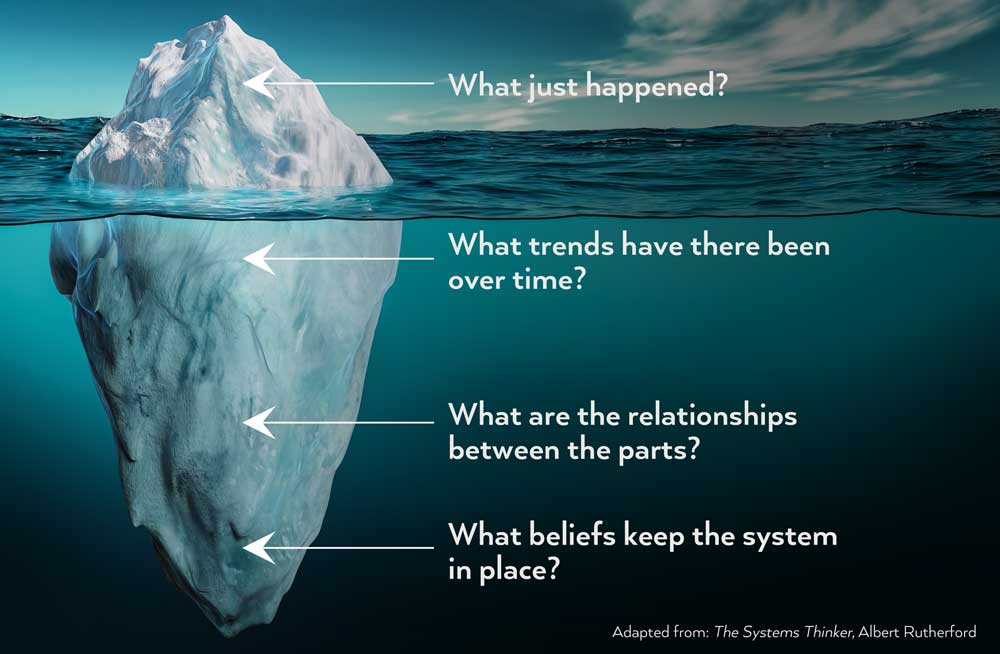
The iceberg model encourages us to look beneath the surface, exploring the root causes, recurring patterns (behaviors), and underlying beliefs and values that drive visible outcomes. Systems thinking invites us to examine the relationships and feedback loops that shape these outcomes, asking questions that build awareness of how structure and behavior are interconnected.
As Bansal and Birkinshaw note, systems thinking asks us to move beyond linear solutions, focusing instead on interdependence, flows, and desired future states that evolve through collective inquiry.
At its core, systems thinking helps clarify where we’re heading, reminds us that complex problems rarely have a single definition or solution, and draws attention to the flows and interdependencies that influence the outcome. This kind of inquiry deepens our understanding of the systems we inhabit and helps align our decisions with the desired future state—our North Star.
As the saying goes, “If you don’t know where you’re going, any road will get you there.” And yet, sometimes simply wondering, allowing space for curiosity rather than certainty, is what’s needed. Engaging in a thought experiment can illuminate the actions and intentions that move us closer to that North Star, often an enriched state of being.
Crowdsourced Accountability
When we reframe a situation, we begin to see what’s possible. Considering potential consequences and opportunities for improvement can reveal what might need to shift for existing systems to support a more integrated outcome.
This is where crowdsourced accountability matters. Involving diverse voices, especially those who experience systems differently, broadens our perspective and helps us break free from echo chambers. In our collective rush to move fast, this reflection step is often skipped, leaving valuable insights behind in the name of speed.
While “move fast and break things” might fuel innovation in certain industries, in complex human systems the collateral damage often outweighs the benefits. Leaders today are being asked to meet societal challenges while balancing organizational priorities. But leadership isn’t an individual act; it’s a collective process that calls for courage, humility, and the willingness to listen deeply.
We are already seeing the social and human consequences of breaking systems without guardrails. Systems thinking may seem slow, but wisdom often moves at a different pace. It might not suit every organization or every leader’s style, yet the question remains: How are you designing your future state, and what does your North Star represent now?

Source of Inspiration
What I'll be reading
I’m beginning Right Story, Wrong Story by Tyson Yunkaporta, a book deeply rooted in the Indigenous practice of “yarning”—a communal, conversational form of storytelling that weaves individual experiences into a shared narrative. In this approach, contradictory perspectives are welcomed, and stories evolve collectively rather than belonging to any one voice.
This book continues the work Yunkaporta began in Sand Talk, which I read in 2020 and still think about often. One line in particular has stayed with me: “Solutions to complex problems take many dissimilar minds and points of view through dynamic interaction networks.” It’s a humbling reminder to slow down, listen deeply, and embrace complexity instead of chasing simple answers.
I’m looking forward to exploring how Right Story, Wrong Story expands on that idea—how collective, even conflicting, voices might help us make better sense of our shared world.
Song that inspires
While listening to, When Yuh Right, these lyrics caught my attention:
“Though it’s gonna be really rough,
Sufficient is the good in us.”
They reminded me of a reflection from the When Good Enough Is Good Enough blog—how might we be okay with good enough, trusting that it’s sufficient in this moment?
I invite you to listen to this tune and consider what sufficiency means for you.
Reflection
Algorithms. Algorithms. Algorithms.
I’ve been thinking about the hidden benefits and harms of algorithms and how they shape our behavior, including my own. The only social platform I use is LinkedIn, and recently I received an alert saying my engagement was down -100%. I hadn’t added any new connections and was being nudged to post and engage more.
How is this information helping? LinkedIn? Me?
It makes me wonder about the risks of applying deterministic algorithms to something as human as relationships. When these systems treat connection as static or reduce it to clicks and impressions, we lose sight of the nuance that defines genuine engagement.
Speculative algorithms rely on best guesses drawn from past data to predict future behavior—a weak substitute for truly understanding what people value. I took a month off from the platform, intentionally, to see what would happen. The insight was useful, but it didn’t make me want to engage more.
Truth be told, I had already been trying. Despite nearly 5,000 connections, only a tiny fraction engage with what I share. Of course, I don’t expect everyone to be in relationship with me or my content, but it does make me question the value exchange.
Lately, I’ve been reassessing how much time and energy I invest in the algorithm itself.
What’s your relationship with algorithms?
While I Still Have Your Attention
Thanks for reading BETA’s blog! I hope this month’s reflection sparked new thoughts about how stories shape leadership styles—especially during times like these, when everything’s shifting so quickly. Taking a step back to gain a broader perspective can help us break out of echo chambers and lead more clearly and purposefully.
If you’d like to explore how BETA Coaching & Consulting can help strengthen employee well-being and the emotional culture of your organization, I’d love to connect. Book a 1:1 with me
Well-being is both deeply personal and universally desired. It shapes how we function as individuals and as a community, and how we experience our lives as a whole.
If this newsletter resonated, please share it with a colleague, friend, or loved one. And if you’re not yet subscribed, I’d love to have you join our list. Your email is always kept private, never shared.
Let’s also stay connected on LinkedIn.
Thank you!