
The Lightbulb Moment: Where BETA’s Work Began

I’ve had the profound privilege of being present with hundreds of people as they shared what they desired most for their well-being. Many of them didn’t know it yet. Over time, they slowly realized what needed to change for them to be well.

Then the light bulb went off. How could these insights, taken together as aggregate data, inform the way an organization offers well-being strategies to its workforce?

The patterns were hard to ignore. At times, I had up to 100 coaching clients in the queue. Many shared that although their employers encouraged work-life balance, they felt unsupported in actually reaching their goals. 

Systems, policies, and procedures worked against the very things they were striving for, like work-life integration. (Think of a culture that expects email replies while you’re home or on vacation.) When I shared these observations with higher-ups, they treated them as information, not as an opportunity to build a true culture of well-being.

So I set out to build that bridge myself.

Being well isn’t a solo endeavor resting squarely on one person’s shoulders. It’s a collaborative change-management process, with real opportunities to move the needle.

Bringing those two worlds together, the individual and the organizational, has never been a straight path, or a simple one.

Today’s workforce is wonderfully diverse, and not just racially. We’re talking age, neurodiversity, disability, and more. Some organizations have five generations working side by side, each with its own well-being needs. Getting to be part of the solution, even on a small scale, has always excited us at BETA.

Read a few client stories for a glimpse of how I partner with clients.

Why does well-being matter, especially at work?

First, let me level set. People often use wellness and well-being interchangeably, but they aren’t the same.

  • Wellness refers to physical health and the lifestyle choices that help prevent illness.
  • Well-being goes further. It captures the broader, holistic dimensions of a well-lived life: our emotional, psychological, social, financial, and professional lives.
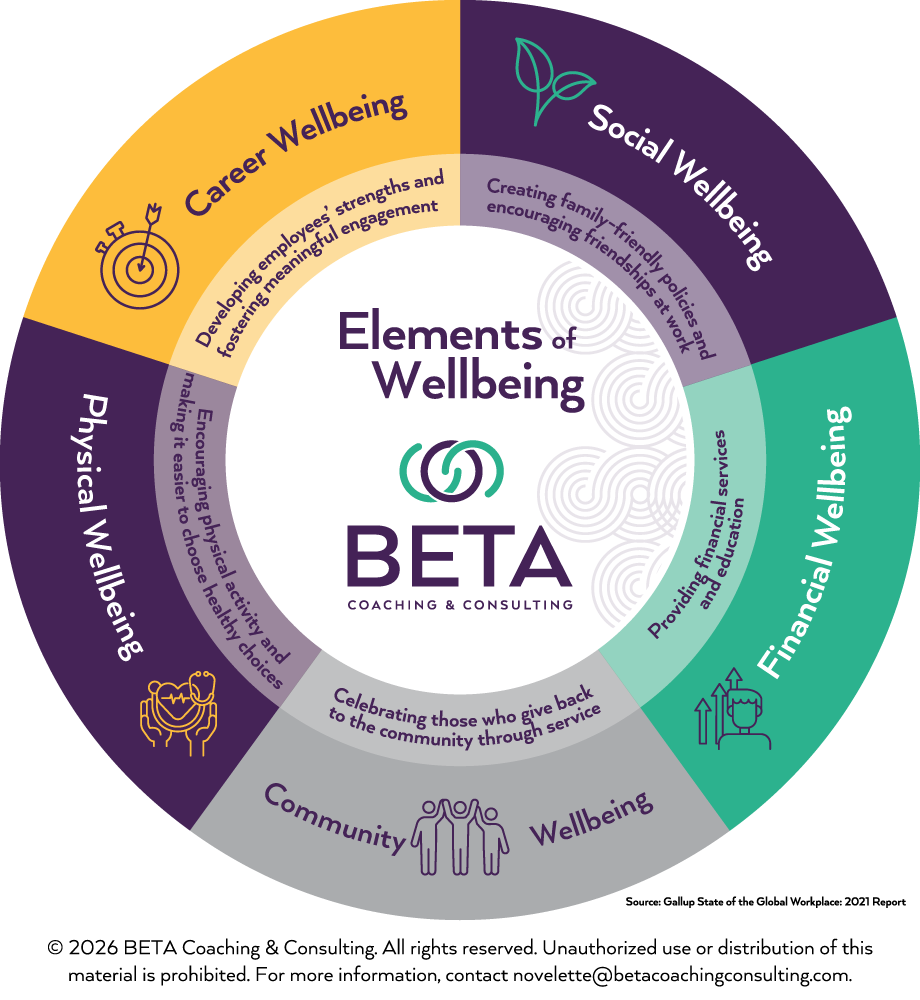

After more than 20 years as a well-being professional (14 as a coach and 6 as a consultant), I’ll admit my bias. There is magic in partnering with clients on their well-being journeys and watching them reach their own versions of success.
Well-being is a journey, so we’re always recalibrating. Success keeps evolving.

And let’s be frank. Organizations are in the business of making a profit. In today’s business climate, a well-being initiative, however well-intended, may not be top of mind. Yet one truth holds: when an organization affirms the value of every team member, it drives both performance and well-being.

Well-being is not a byproduct of efficiency.

It is an essential part of being effective.

Putting that into practice takes daily decisions that build a culture with workforce well-being front and center. It also takes understanding that investing in employee well-being doesn’t take away from the bottom line. It strengthens it.

De Neve and Ward write in their book Why Workplace Wellbeing Matters: The Science Behind Employee Happiness and Organizational Performance, “Companies with higher levels of employee well-being have higher valuations, stock market returns, greater sales growth, stronger earnings-to-asset ratios, and more frequent earnings surprises.”

If I sound like a well-being evangelist, it’s because I believe a well workforce is essential to a well society. We spend so much of our lives at work, building skills and growing in our professions. Sometimes that comes at the expense of our families and our own well-being.

The opportunities are boundless for each of us to be our well-selves. But collectively, we are only as well as the least well person.

“Companies with higher levels of employee well-being have higher valuations, stock market returns, greater sales growth, stronger earnings-to-asset ratios, and more frequent earnings surprises.” 

—De Neve and Ward 

So if well-being is a business strategy and not a perk, who carries it forward, and how? The answer might surprise you. We’ll pick up right there in Part 2.


What’s Inspiring Me Lately

Reading is the sole means by which we slip, involuntarily, often helplessly, into another's skin, another's voice, another's soul.

What I'm reading

A few books keeping me company in October.

Playlist for the Month

For your listening pleasure: a soundtrack for October.

Whether you’re leading a team or tending to your own well-being, let’s talk. Book a complimentary 15-minute Zoom call with Novelette.

BETA Coaching & Consulting wants to know what you thought of this article. Click to rate this post!
[Total: 0 Average: 0]
LinkedIn
Twitter
Facebook
Sign up to receive Novelette's monthly newsletter

Subscribe

* indicates required
Disclaimer: By providing your email address. You agree to receive communications from BETA Coaching & Consulting. We respect your privacy and will never share your email address with third parties.


Novelette A. DeMercado, MS, PCC, CPDC, NBHWC
Founder/Chief Possibility Director

I’m drawn to the process of learning – the possibilities it holds – of things yet to be realized. Continuously expanding the sphere of understanding is a delight that transports the imagination. I set high expectations for myself, which signals confidence in my capacity to deliver outstanding results. Completing the task is its own reward and that internal drive motivates the journey.

On LinkedIn
By Scheduler
By email