In Part 1, I shared how BETA came to be and why well-being belongs in business strategy. I left you with a question: who carries it forward, and how?
It isn’t necessarily the person with the biggest title.
An Effective [Change] Leader
The Harvard Business Review has long been my go-to source on leadership. Its many articles on what makes a leader all point to the same truth: holding a leadership position doesn’t make someone a leader.
As I’ve said, well-being strategies are change-management strategies. Leading people through change means removing the barriers that stand between them and success.
To lead, you connect, motivate, and inspire. It’s a continuous journey, both personal and professional, and it calls for fearless introspection. If you’ve been following BETA’s blogs, you know I’m big on introspection. It also takes seeking feedback and building practices that sharpen your skills over time.
What makes leading possible is a tolerance for failure. Another way to see it: leadership is trial and correction. As a change leader, you know organizational change initiatives fail more often than they succeed. Those failures are moments of great insight that fuel the next iteration, as long as we learn from what went wrong instead of scrapping everything that went right.
Connect, Motivate, and Inspire
When leaders invest in meaningful connections and align employees’ values with organizational goals, employees thrive, innovate, and help the organization adapt as conditions change. Connecting the company’s purpose to its environmental, social, and enterprise goals is another valuable way to support its talent and their well-being.
Organizations with a deep sense of purpose go further through job crafting, which means shaping roles together with employees so they’re more engaged and fully involved. That builds a culture of well-being. When organizational goals align with individual strengths and aspirations, employees feel valued, supported, and motivated to contribute meaningfully.
Inspiring others to bring their best requires understanding, across the whole enterprise, how to welcome and respectfully support the best in every contributor. When leaders model that through their own actions and behaviors, employees follow.
Now imagine what your organization could achieve if every employee had the chance to identify, engage in, and adopt behaviors that support a well life, with systems, policies, and procedures working for them instead of against them.
A Framework for the Work
When I’ve worked with organizations to build lasting well-being change, including an employee-owned company and a health care provider, having a framework to guide the initiative brought real clarity.
A [sustainable / stability & change] well-being framework offers structure while staying flexible enough to meet the needs of individual employees and the organization’s priorities.
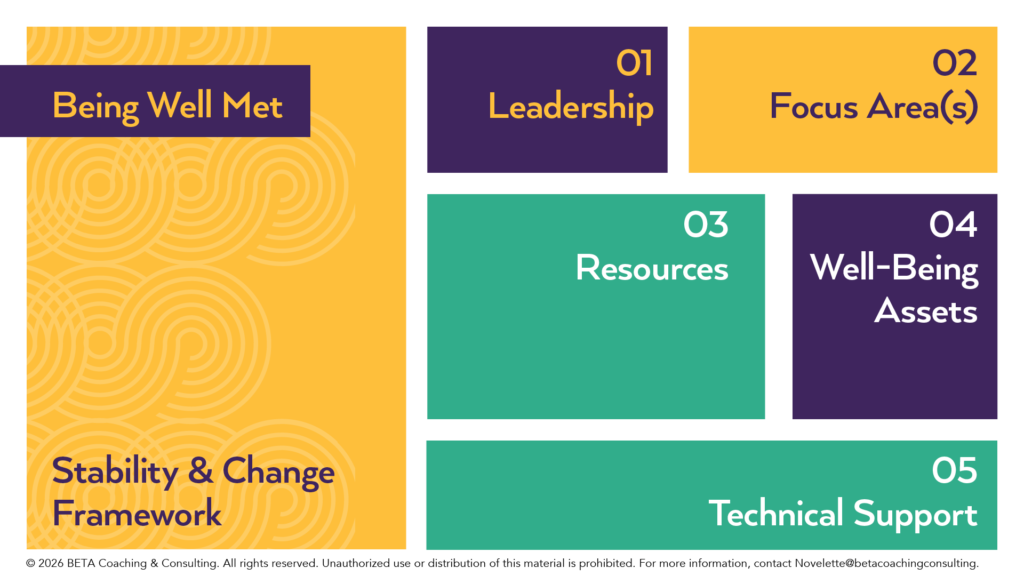
The framework has five parts. Here, I’ll spend the most time on leadership and give you a quick look at the other four. Each one will get its own spotlight in a future blog.
01 Leadership
01 Leadership makes one thing clear: leadership is a team activity. No single leader has every attribute needed to manage change in an organization. No single leader can account for everyone’s needs while keeping things workable for most, either.
Leading is a social process, and it involves building psychological safety throughout the organization. Leading through change means making the case for the change; listening, listening, listening, and listening some more to stakeholders; implementing the strategy; and celebrating small wins while learning from what didn’t work.
02 Focus Area(s)
Leaders and stakeholders choose the focus areas of the well-being strategy and decide how to measure success. Here, KPI stands for keeping people inspired. The plan stays nimble enough to course-correct when needed.
03 Resources
This means identifying the internal resources the organization can build on and the external resources it needs. It’s also the time to remove or reduce as many barriers to success as possible, with an eye on what will keep people inspired to be well.
04 Well-Being Assets
The organization builds a library of well-being assets, or opportunities, that meets the needs of its whole workforce. Then it communicates, communicates, communicates what those assets are and how to access them. A dedicated team keeps the library current and relevant in an ever-changing environment.
05 Technical Support
The organization designs or purchases a platform that is encrypted, private, and HIPAA-compliant, then rolls it out so everyone knows how to access it. Data from the platform should be de-identified to inform future planning.
Beyond the Surface
Because a workplace is made of many interdependent parts, understanding what drives organizational well-being requires a systems-level view. In other words, it requires a change-management process.
Well-being initiatives call for a culture strategy. Culture and strategy reflect and amplify each other, and everything in an organization is connected, even when we’re working in silos.
Standalone programs, wearables, and digital platforms, however well-intentioned, can’t create lasting, meaningful change in employee well-being on their own. They have to evolve to keep the human at center: the whole person on the other end of every program and platform.
That matters even more now. The jury is still out on how AI well-being apps will affect individuals’ engagement or how well they actually feel after engaging with an AI bot.
Well-being is a central strategy for making sure each of us can contribute our best, navigating our many challenges while negotiating what we need. Strategies that support employee well-being are relational. They grow from understanding the human at the center.
What’s Inspiring Me Lately
Reading is the sole means by which we slip, involuntarily, often helplessly, into another's skin, another's voice, another's soul.
—Joyce Carol Oates
What I'm Looking Forward to Reading
It’s a mystery!
I can’t wait to unwrap this book and immerse myself in its pages.
What are you quietly anticipating for November?
Playlist for the Month
What songs on your playlist have stirred your heart?
Curious what well-being could look like for you or your organization? It starts with a complimentary 15-minute conversation.
May this season illuminate new insights and find you well.