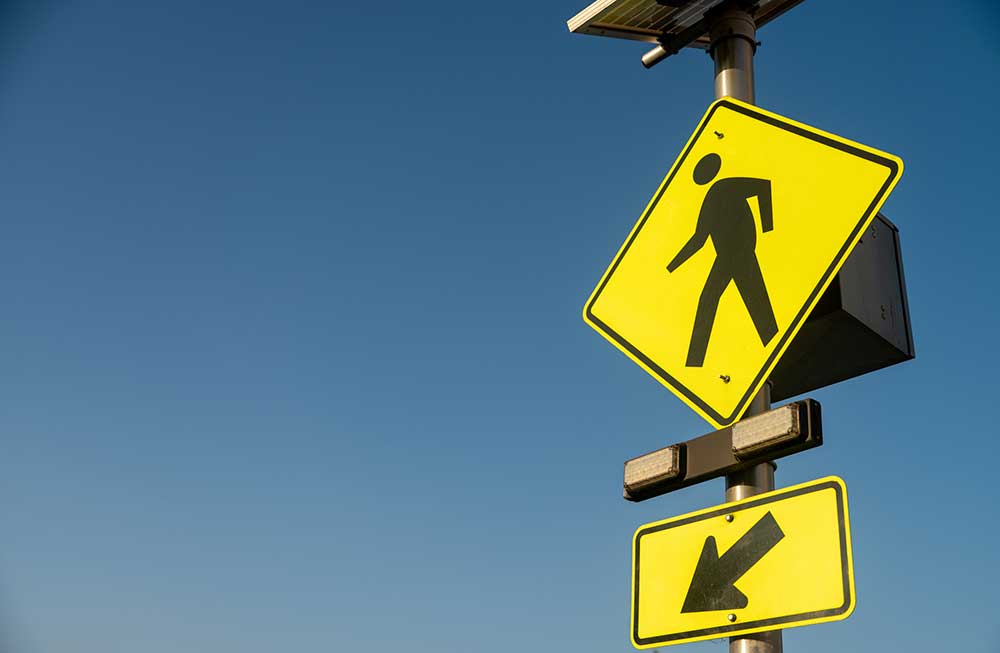
Proud to say I live in a state where pedestrian crossings are clearly marked. In some cases, there’s an amber flashing signal to alert motorists that a pedestrian wishes to cross.
I’ve been thinking about crosswalks, especially since I’ve been physically challenged to get to the other side of the street. This winter, during severe storms, pedestrian curb ramps were obstructed. High blocks of ice-packed snow were plowed onto the curb ramps. Where the curb ramps were blocked, it felt like a negotiation with motorists, beyond the usual negotiation.
Whether it’s winter or spring, I’ve noticed a type of aggressive motoring. Cars screaming down the road. Drivers looking way off into the distance. And in a worst-case scenario, eyes on phones as they blast through crosswalks.
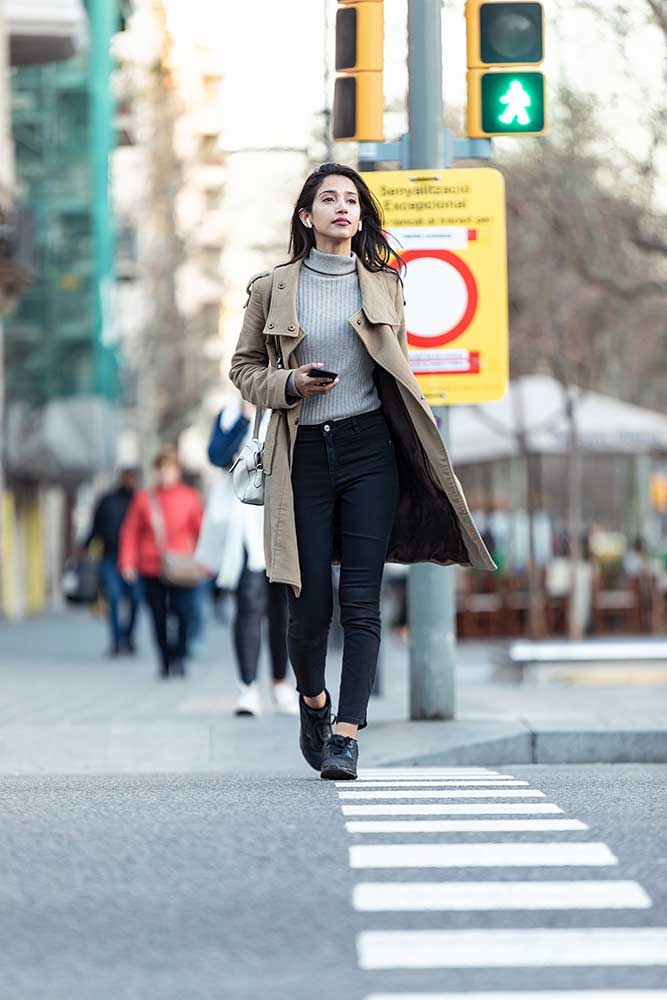 Crosswalks are a must if you want to get to the other side. They are meant to offer protection, including as a pedestrian refuge island. Yet even protected spaces can feel unsafe. Precarious, at best.
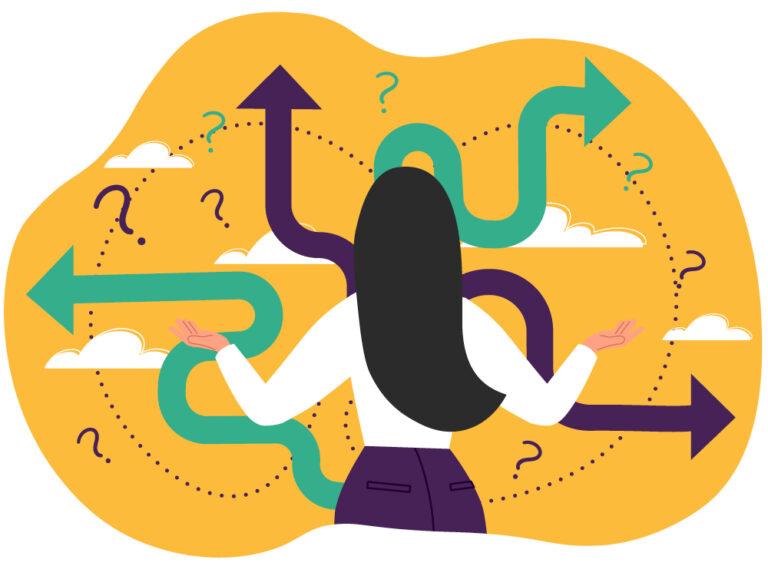
Many of us are working toward crossing to the other side. We are charting a new course and, at times, encountering an obstruction. Sometimes it’s the relentless flow of input that makes the journey feel impassable. Sometimes locating protected space is elusive. These moments can ignite discouragement, irritation, determination, a wait-and-see attitude, or the decision to change course, if that option is even available.
This experience of trying to cross to the other side, while waiting at a pedestrian curb ramp, has me thinking about all that has happened in the past few months, and years. While uncertainty is the nature of human existence, so much uncertainty is swirling around that many of us may feel tenuous about how to cross over.
Whether these uncertainties stem from a cost-of-living squeeze, economic uncertainty, a turbulent labor market, AI disruption, shifting geopolitics, or the climate crisis, individuals and organizations are feeling distressed.
To say there is a lot of uncertainty is a huge understatement.
All of these uncertainties impact our well-being. They also impact the ways in which the workforce experiences work, influencing an organization’s operations. I implore you not to reduce well-being to the aesthetics of physical appearance, but to take in the whole of the person. The whole of yourself.
More than ever, the call is to move from one-size-fits-all models to emergent strategies. Strategies where solutions for transformation are living systems that continue to evolve amid uncertainty. I would like to say we’re arriving. Yet we have not arrived, given what is happening in the ecosystems. (Re)clarification is ongoing through innovative collaboration and the disruption of what we thought we knew, also known as the status quo.
 To cross over to the other side is to acknowledge that change is constant, even the changes that are most unwelcome. In adrienne maree brown‘s Emergent Strategy, they note there is always sufficient time to consider the action that will result in a small, good-enough solution that reflects the grand solution.
Who do you need to be in conversation with to negotiate this crosswalk? Who do you need to be in relationship with to maneuver it?
And when you fail, and you will fail, what was the lesson? What did you learn from the process?
Above all, trust those who are on this journey with you. When we focus on critical connections, people become trustworthy.
According to Audre Lorde, “There is no such thing as a single-issue struggle because we do not live single-issue lives.” Our complex lives are colliding at many crosswalks. There will be moments you will want to stand at the pedestrian curb ramp, discouraged, irritated, determined to push through, choosing wait-and-see, or changing course.
There are many pulls for our attention. There are many crises and threats to grapple with. Capacity management will be key.
Being creative to get to the other side is called for. That creativity happens with others, in a relational, adaptive, fractal, and interdependent manner.
And since there is no single issue concern, this begs the question. Where is the sweet spot, or the pain point, in negotiating that crossing? Where are you placing your attention, and what is it you wish to grow from crossing to the other side?
Here’s to safe crossing.
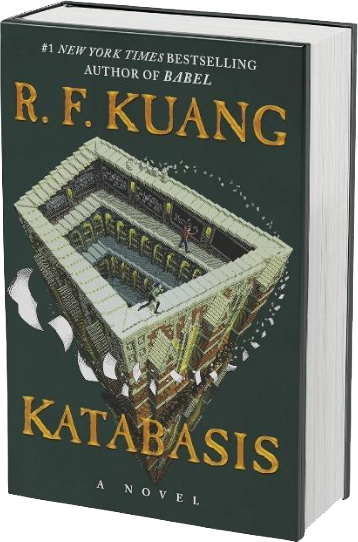 To say I loved Kuang’s previous book, Babel, would be an understatement. I’m so excited to read R. F. Kuang’s latest book, Katabasis, which I received as a gift.
Reading the inside cover, I learned the word katabasis (a noun), in ancient Greek, is the story of a hero’s descent to the underworld.
Not dissuaded by the book receiving mixed reviews, I am pumped to curl up with all 541 pages this April.
What are you looking forward to reading this spring?