
At a recent panel discussion, the moderator opened by asking the panelists and the audience what we understood by the phrase “cognitive flexibility.”
It was a new concept for me, and it caught my attention right away. Learner is one of my top five CliftonStrengths, so when I got back to my home office, I started researching. Just saying, I challenge myself to keep learning.
Cognitive flexibility theory recognizes that some areas of knowledge are complex and ill-structured. So how do we learn concepts across contexts and perspectives in our personal and professional lives, so that what we know carries over into new situations, especially the messy, complicated ones?
That question intrigues me. What conditions might help me stay flexible when I face an opposing point of view?
I believe it takes openness and receptivity. Honestly, we may not need a label like “cognitive flexibility,” but having one gives us a common language.
Being human, I know I can be inflexible and less receptive at times. How about you?
I’m curious not only about why I do what I do, but also about what makes that kind of flexibility possible. That’s the learner in me, always looking for ways to expand what I know. I’m also aware that sharing what I learn could feel like imposing my values on others. So I offer this as a perspective, not a prescription. Here goes.
Context matters. How we perceive a potential outcome often shapes how we feel about it, and whether we resist or open ourselves to what’s unfolding. Neither response is inherently better than the other.
We are in uncertain times, and when have we not been? Weathering the storms of uncertainty takes a toll on our psychological and emotional well-being. That’s true whether you lead an organization or contribute to one.
It’s easy to be pithy when things are going well. It’s a different story when you’re on shaky ground. That’s where cognitive flexibility comes in. The Center for Mindfulness & CBT describes it as “the ability to switch between different concepts, perspectives, or ways of thinking,” which “allows us to adapt our behavior and thinking when situations change, new information emerges, or obstacles arise.”
So we adapt. We pivot. Pivot! Pivot! Pivaat! We meet the demands of the moment.
But sometimes pivoting feels hard, even out of reach. Some people have constraints that make it hard to pivot on a dime. Some organizations are like massive ocean liners that can’t turn quickly in choppy waters. So I resist the oversimplification that pivoting is always the answer. First, I try to understand, as best I can, the context a person or organization is operating in. Then I ask: what’s one thing you can do in this moment, with the resources you have?
A pivot doesn’t have to be a major departure from the original objective. It can be a new pathway to the same objective, or a new objective that still gets you to the destination you want. Pivoting is about refining the process based on context and perspective.
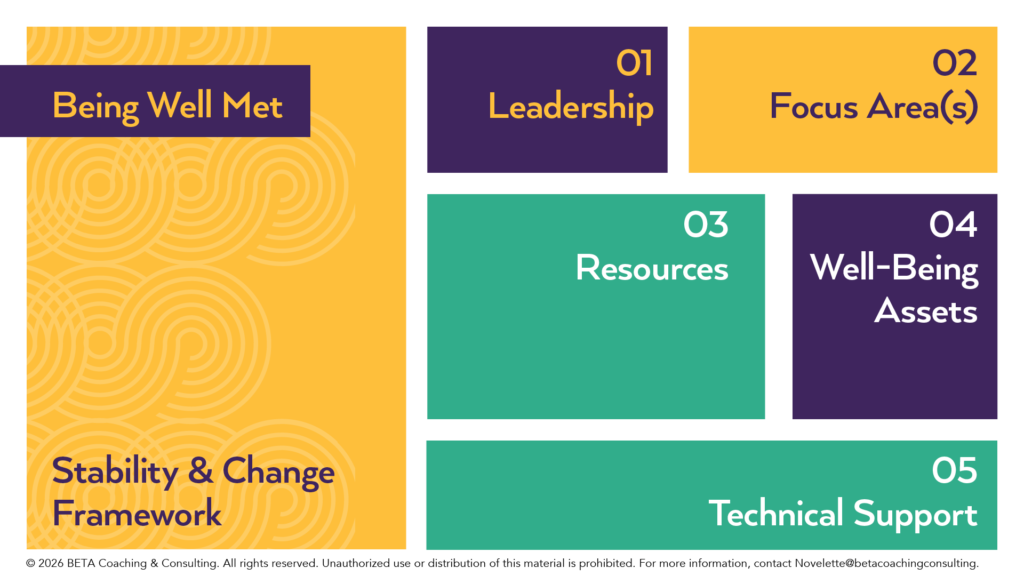
That balance, holding steady on where you’re headed while staying open to how you get there, is built into how we work. At BETA, we created the Stability & Change Framework to help organizations take a holistic approach to their well-being strategy. It’s designed to improve well-being for individuals and for the organization as a whole, while strengthening how people work together.
At the heart of the framework is our coaching approach: participants engage as equals, grounded in trust, transparency, choice, and a willingness to pivot.
In October, I introduced the framework’s five parts and promised to spotlight each one in future posts. This month, it’s 02 Focus Area(s). Often, a focus area comes down to the one thing that matters most to many in the organization in that moment. And to keep people inspired, the plan stays nimble enough to course-correct.
This is where the big picture (what’s my one thing?) and the small focus (what’s my one thing right now?) collapse all possible questions into one: what’s the ONE thing that can be done so that everything else becomes easier or unnecessary?
Sit with that question for a bit. We’ll pick it up right there in Part 2.
What I'm Reading
Reading is an immense gift, but only if the words are assimilated, taken into the soul – eaten, chewed, gnawed, received in unhurried delight.”
—Eugene H. Peterson
What I'm reading
Most days are good days to curl up with a book, but autumn days are especially delightful. Here’s what I’ll be reading this November.
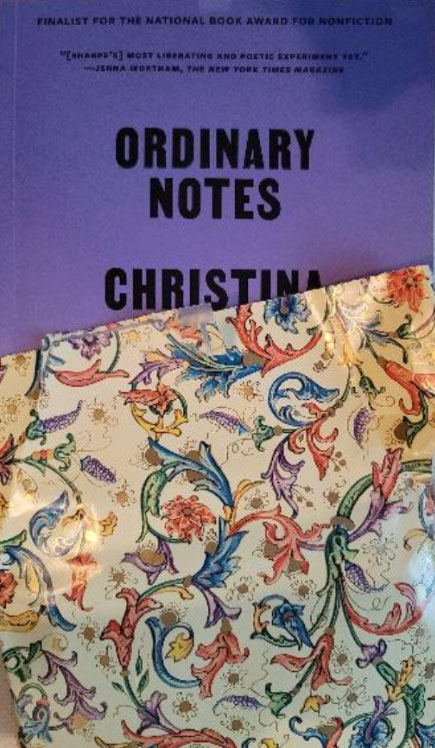
November’s mystery book, unwrapped: Ordinary Notes by Christina Sharpe
What are you reading, in unhurried delight, this month?
Playlist for the Month
For your listening pleasure: a soundtrack for November. Do you have a favorite song from the playlist?
Facing a pivot, in your own life or across your organization? Let’s talk it through. Book a complimentary 15-minute Zoom call with Novelette.