
Are you a meanderer, or do you head straight for the destination?
I love to meander when there’s no urgency to get anywhere. It’s all about exploration and what might be discovered along the way. But when you’re aiming for a specific destination, meandering may not be the best modus operandi. Efficiency might demand that you get your ducks in a row and get going. As the saying goes, “If you do not know where you are going, any road will take you there.”
I don’t believe it has to be one or the other. The straight path and the meandering one can coexist, especially when you’re developing, designing, and delivering organizational culture change, like a well-being strategy.
As I shared in Part 1, this month’s spotlight is 02 Focus Area(s), and it’s all about KPI: keeping people inspired. And inspiration starts with purpose.
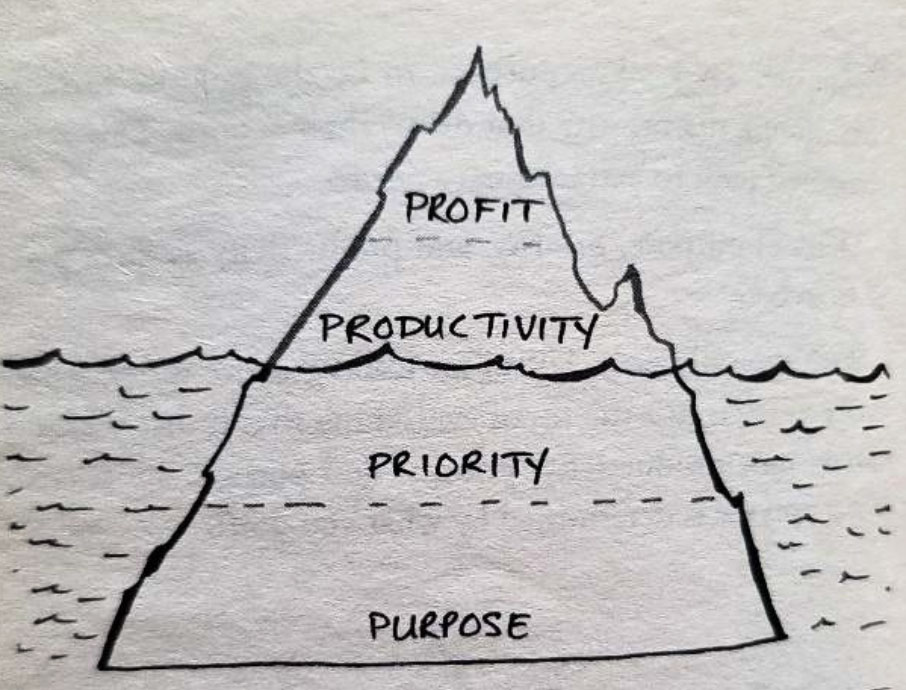
Image source: The One Thing, Gary Keller with Jay Papasan
Purpose sets priority. Priority drives productivity, or performance. And productivity leads to profit. [Notice that what everyone sees, productivity and profit, rests on what sits below the surface.]
That priority is your ONE thing, and it grows out of purpose. When purpose is clearly defined, for the organization and for each individual, clarity comes faster and creates a stronger sense of direction. And when you need to pivot, you know which way to turn.
Because a well-being strategy is an organizational strategy, it aligns with the organization’s purpose. And when leaders share their own purpose and how it connects to the organization’s, they inspire employees to do the same.
When leaders encourage employees to define their own well-being and align their behaviors with the organization’s purpose, those employees recognize the impact their work has on others, and they experience greater satisfaction.
The framework works best alongside a strong transformative partnership with the organization’s leadership. That partnership involves five things:
- Establish a clear vision for the framework. Agree on a better future state, and ask: why are these changes better than the way things are now?
- Align on the value proposition. Understand what can be accomplished by working in partnership, and create a pathway for transformative change.
- Co-create. Take time to understand the context and the desired change before starting the process.
- Track performance. Proactively monitor the strength of the partnership, and course-correct as needed.
- Measure change. Determine whether the changes are scalable and sustainable enough to meet the original objectives.
When leaders articulate the big picture while staying focused on the one thing we can accomplish right now, it becomes a beacon for the organization, like the light from a lighthouse. Even as I write this, I don’t want to oversimplify how complex it is to align those two focuses: the big picture (what’s my one thing?) and the small focus (what’s my one thing right now?). Or what it will take to engage stakeholders in the process.
Of the framework’s five components, I believe Focus Area(s) will take the most time. It won’t be plug-and-play or a turnkey strategy if the design is truly meant to serve the organization and the people who work there.
This is roll-up-your-sleeves work, a back-and-forth negotiation. It goes beyond consensus-building. It’s a deep integration, a transformative process. Let me say it again: this will take time. And that investment of time is equal to, if not greater than, the financial investment it takes to design and deliver the well-being strategy.
There needs to be comfort with being a little uncomfortable, because there will inevitably be disagreements about the best focus area(s). We’re talking about individual contexts and perspectives within a complex system, while arriving at a decision for the good of the many. This might translate into how we support traditionally excluded individuals.
It’s worth saying again: well-being is not a byproduct of efficiency. It is an essential part of being effective. A well organization is purpose-driven, creative, and healthy, and it inspires new possibilities.
Creating culture change while shaping expectations means understanding context, challenging the status quo, discovering new perspectives, and designing for adaptive change.
Cognitive flexibility in complex domains (and what could be more complex than a human network?) comes into play when knowledge from different people is brought together to meet the moment. In many ways, that’s what BETA sets out to do: meet the moment by tailoring our services to the needs of each individual and organization, drawing on input from many different people.
Well-being initiatives are designed to hold multiple perspectives without oversimplifying the impact they will have on people’s lives.
What would happen if we, as leaders, encouraged and measured goals that prioritize the well-being of all employees? And what are some ways to inspire and engage them?
What I'm Reading
Reading is an immense gift, but only if the words are assimilated, taken into the soul – eaten, chewed, gnawed, received in unhurried delight.”
—Eugene H. Peterson
What I'm reading
Most days are good days to curl up with a book, but autumn days are especially delightful. Here’s what I’ll be reading this November.
December’s mystery book, still under wraps. Any guesses? I’ll reveal it next month.
What are you reading, in unhurried delight, this month?
Playlist for the Month
Still on repeat: November’s soundtrack. If you missed it last issue, press play and let it carry you into the season.
What’s your one thing, for yourself or your organization? Let’s find it together. Book a complimentary 15-minute Zoom call with Novelette.